
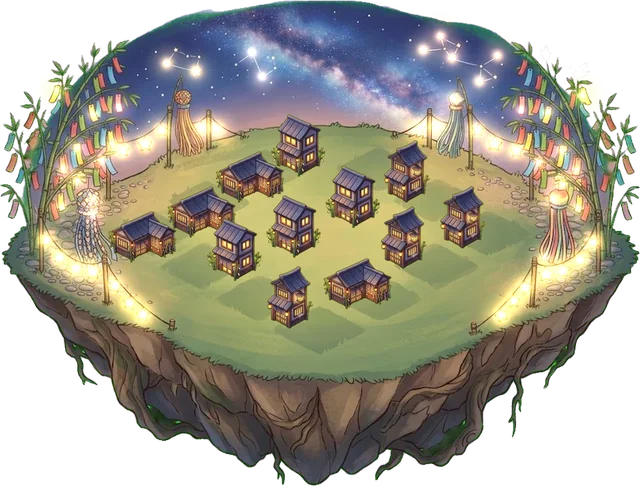
What is Tanabata?
The festival comes from an old legend shared across East Asia: the weaver princess Orihime (the star Vega) and the cowherd Hikoboshi (Altair) were so in love that they neglected their work, so the princess's father separated them on either side of the Milky Way. They may meet only once a year, on the seventh day of the seventh month.
When Japan switched to the Western calendar in 1873, most places moved the festival to 7 July, while others, such as Sendai, kept it a month later, closer to its old lunar date.
When is Tanabata? Dates for 2026 and 2027
2026
- Tuesday 7 July 2026Tanabata
- 6–8 August 2026Sendai Tanabata Matsuri
2027
- Wednesday 7 July 2027Tanabata
- 6–8 August 2027Sendai Tanabata Matsuri
Most of Japan celebrates on 7 July. The Sendai Tanabata Matsuri, the most famous of all, is held on 6–8 August every year, and some towns choose dates in between.
How people celebrate
- Writing wishes on tanzaku (paper strips) and hanging them on bamboo with paper decorations.
- Huge paper streamers (fukinagashi) hanging over the shopping arcades of Sendai.
- Wearing a light summer kimono (yukata) and visiting the festival stalls.
Good to know
- Look up on a clear night: Vega and Altair are two of the brightest stars of the summer sky, on either side of the Milky Way.
- 7 July falls in Japan's rainy season, so the lovers often can't meet; rain on Tanabata is sometimes called their tears.
- The Shonan Hiratsuka Tanabata festival, near Tokyo, is another of the big celebrations in July.